A reviewed hull finding is an input to a maintenance decision, not the decision itself. The responsible team must consider the condition, its location, the possible consequences, the reliability of the evidence and the applicable requirements. An automated severity label cannot safely compress all of those considerations into a universal repair priority.
The practical objective is to connect the finding to a controlled next step. That step may be further examination, a repair assessment, a planned intervention or an explicitly justified monitoring arrangement. It should have an owner and a clear basis. Leaving a finding in an inspection report without assigning responsibility is not a maintenance strategy.
Clarify the condition before scheduling work
Start with the reviewed observation and its limitations. Is the evidence sufficient to establish the condition, or does the team still need measurements or another inspection method? Separate the physical extent that has been observed from the extent that is suspected. A planning estimate may be necessary, but it should not be presented as confirmed condition.
Where there is concern about immediate safety or fitness for service, follow the vessel’s established escalation procedures and consult the appropriate competent parties. A general information website cannot determine whether continued operation is acceptable. Nor should a software workflow allow a potentially serious concern to wait silently for the next routine planning meeting.
Prioritise with consequence and uncertainty
Two visually similar findings can have different significance because their locations, structural functions and operating contexts differ. Consider access, exposure, previous repairs, adjacent features and the consequences of deterioration. Uncertainty also matters: incomplete evidence may justify earlier examination rather than a lower priority simply because no severity has been confirmed.
Monitoring is an active choice, not a synonym for doing nothing. Define what will be checked, by whom, using which method and what change would trigger further action. Establish a review point through the vessel’s appropriate procedures. Do not invent a universal interval from an image score or apply a generic threshold without technical justification.
Make the work package specific
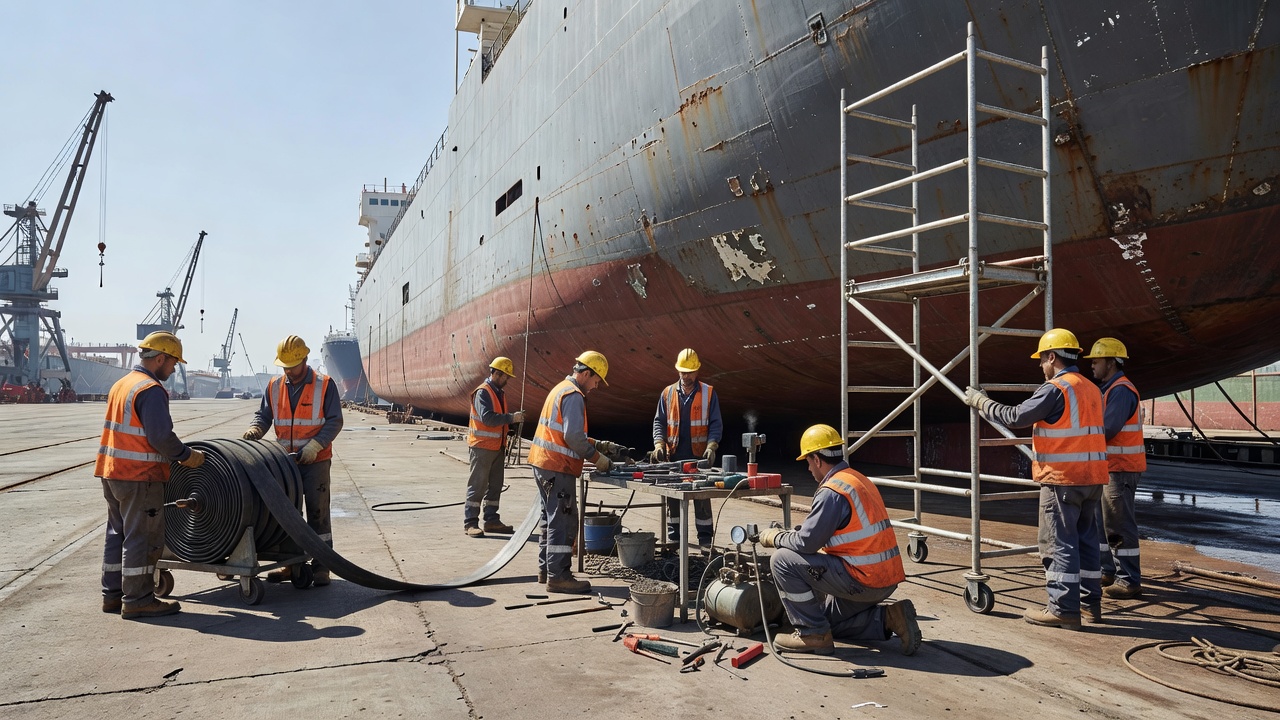
A useful work package links the finding identifier, location references, relevant images and supporting assessment. It defines the intended scope and identifies any prerequisites, approvals or hold points. If further examination could change the scope, describe how that change will be managed rather than assuming that the initial visual interpretation is complete.
Repair methods, materials, welding procedures and acceptance criteria require appropriate technical authority. IACS Recommendation 47 addresses shipbuilding and repair quality standards within its stated scope, but citing it is not a substitute for determining the vessel’s applicable requirements. Consult the classification society, flag administration or other responsible parties where their involvement is required.
Keep execution separate from verification
A contractor’s completion note establishes that work was reported complete. Verification asks a different question: does suitable evidence show that the intended outcome and applicable acceptance requirements have been met? Define that evidence before the work begins, especially where a feature will become inaccessible after coating, closure or reassembly.
Depending on the task, verification may include photographs, examination results, measurements, material records or appropriate acceptance documentation. The required evidence must match the work and the governing arrangements. A clear after-work photograph may be valuable, but it cannot demonstrate every property of an underlying repair.
“Close the work order only when the record explains what completion means.”
Puzzlewhistlereel — follow-through principle
Connect the before and after
Link completion evidence to the original finding rather than filing it only under a contractor invoice or dock report. Retain the pre-work condition and explain any change in location description or finding extent. If several findings were addressed by one intervention, preserve those relationships so that none appears to remain open by accident.
For future comparison, repeat the location and viewing method where practical. Different lighting, standoff, surface preparation and image processing can create apparent change. A model detecting less visible rust after cleaning has not necessarily demonstrated a structural improvement. Distinguish appearance, measured condition and verified repair outcome.
Review the pathway, not just the backlog
Look for recurring failures in the process: findings without owners, unresolved location uncertainty, missing verification or repeated capture gaps. These are actionable maintenance-system issues even when the detector performs well. The most useful improvement may be a better handover convention rather than a new algorithm.
The IMO International Safety Management Code provides an important management context for maintenance arrangements, but a digital inspection tool does not establish compliance by itself. Keep the tool in proportion: it supports evidence handling within a wider system of competence, accountability and safe operation.
Primary reference desks
Read the current framework through IMO, IACS, the European Maritime Safety Agency and the Irish Maritime Administration. Applicable obligations depend on the vessel and jurisdiction.