Hull imaging is the deliberate collection of visual evidence from a vessel’s external structure. Cameras may be carried by an inspector, a diver, a remotely operated vehicle or a robotic platform. Software can help connect those views and highlight areas of interest. None of these arrangements removes the need to define what the inspection is trying to establish.
Start by separating three questions: which surface must be examined, what kind of condition could be visible there, and what quality of image would permit a meaningful review? A broad view may establish location but conceal a fine crack. A close-up may show coating breakdown while providing almost no reliable positional context. Both can be useful when their relationship is recorded.
Define coverage before capture
Build the capture plan around a vessel reference system that the review team already understands. Frames, strakes, compartments, port and starboard designations, and a controlled hull drawing can provide a common language. Do not assume that a video timestamp alone locates a finding. Camera drift, repeated passes and changes of direction can make an apparently straightforward sequence difficult to reconstruct.
Divide the intended surface into reviewable zones. For each zone, record whether it was captured, partially captured, obscured or not accessed. Include appendages and transitions where relevant to the agreed scope. Sea chests, bilge keels, propeller-adjacent areas and complex geometry may require different access or camera angles. A coverage map should make omissions visible rather than merely displaying the vehicle’s path.
Choose the access method deliberately
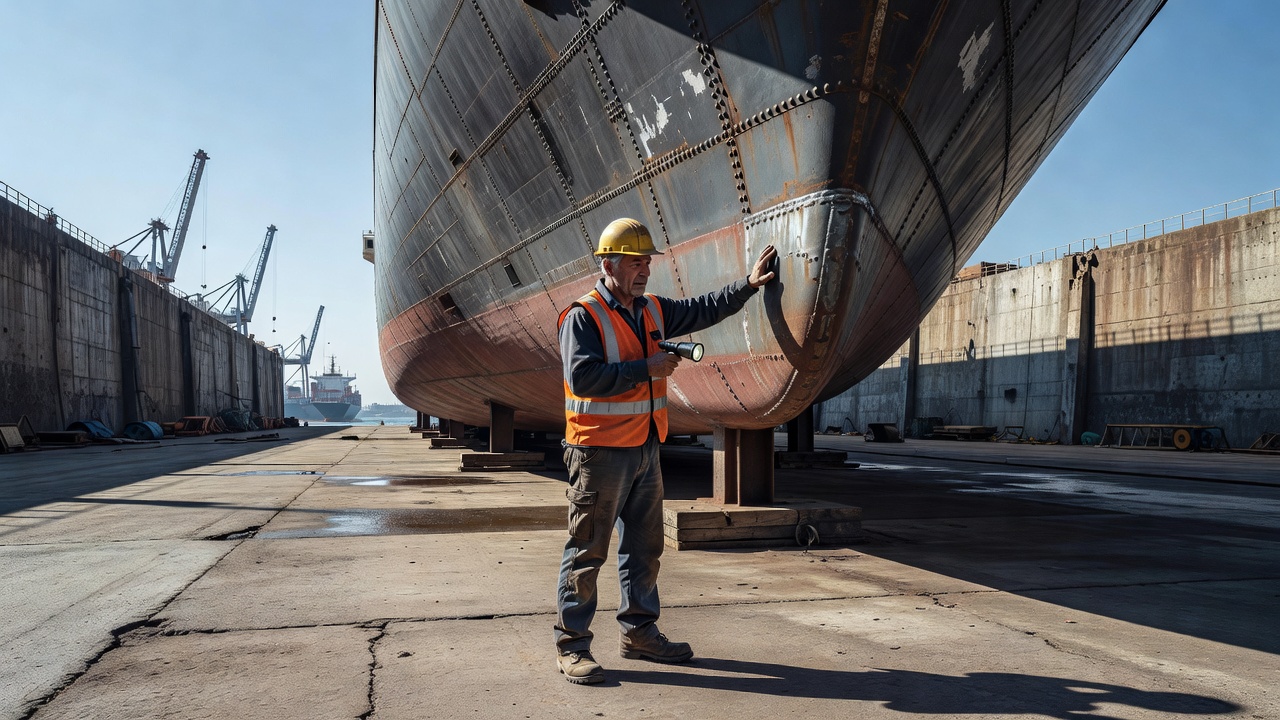
A dry dock can provide direct access and controlled reference points, but shadows, scaffolding and uneven illumination still matter. Underwater work introduces turbidity, backscatter, changing standoff and marine growth. Diver-held cameras offer flexibility, while remotely operated vehicles can support repeatable passes when their positioning and operating conditions allow it. The method must fit the task, access restrictions and applicable safety arrangements.
Biofouling can hide the surface that the inspection is meant to assess. Cleaning may improve visibility, but it also changes the observed condition and can introduce environmental or operational constraints. Document whether images were taken before or after cleaning, and keep those sequences distinguishable. Do not infer the condition beneath growth simply because a model recognises the growth itself.
Make image quality a reviewable decision
Define practical acceptance criteria for sharpness, exposure, scale and coverage before acquisition. These criteria should relate to the intended finding, not merely to the camera’s advertised resolution. Motion blur and compression can erase detail even in a large image. Reflections and harsh lighting can make coating texture appear more significant than it is.
Include contextual and detailed views where feasible. A useful sequence moves from the vessel zone to the local feature and then to a close view with a suitable reference. If a dimensional scale is used, its position and perspective must be understood. A ruler outside the plane of the surface does not automatically produce an accurate measurement.
“An honest coverage gap is more useful than an unsupported claim of completeness.”
Puzzlewhistlereel — capture principle
Preserve originals and acquisition context
Retain the original files alongside any corrected, stitched or annotated derivatives. Record capture time, equipment identity where relevant, acquisition settings, operator and environmental observations. If positioning is approximate, state the approximation and how it was obtained. A composite image can help navigation, but stitching may distort geometry or obscure where source images meet.
Store file relationships explicitly. A model result should point back to the original image or video segment, not only to an exported slide. Changes in colour balance, contrast or cropping should be distinguishable from raw acquisition. This makes later disagreement resolvable: reviewers can examine the source rather than argue over different versions of the same picture.
Hand over a bounded evidence package
The imaging handover should include the scope, coverage map, original media, image-quality exceptions and location method. State which areas require another technique or a return visit. Where class or statutory acceptance is intended, agree the proposed method with the relevant parties beforehand; the existence of an automated capture system does not establish acceptance for a particular survey.
The next stage is not to count every coloured box. It is to assess whether each flagged region has enough supporting evidence for a qualified reviewer to reach a defensible conclusion. Clear capture limits make that assessment faster and more honest.
Primary reference desks
Consult the vessel’s applicable rules and current guidance through IACS, DNV, Lloyd’s Register or ABS. Requirements depend on the vessel, survey and accepting authority.